
Customizing the Go Toolchain for HarmonyOS: Conquering musl Emulated TLS on ARM64
Go’s support for linux/arm64 is remarkably robust—provided you are targeting a standard GNU C Library (glibc) environment.
HarmonyOS (Next), however, adopts musl libc, whose emulated Thread-Local Storage (TLS) mechanics fundamentally differ from glibc’s register-relative offsets. When compiling Go packages into c-shared dynamic libraries (.so) for native NAPI bindings inside HarmonyOS VPN sandboxes, standard Go binaries crash almost immediately upon load.
Here is the complete journey of customizing the Go 1.21.13 runtime across 12 targeted modifications, rewriting the ARM64 TLS addressing model, adapting Linux clone syscall flags, and overhauling cgo runtime initialization.
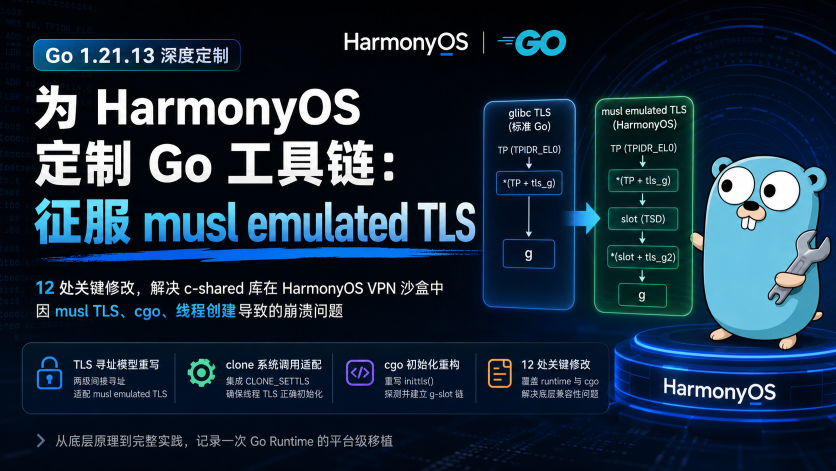
Bridging the Go runtime and HarmonyOS NAPI inside a musl libc sandbox
1. The Problem: Standard Go Crashing on HarmonyOS
1.1 Use Case & Build Target
To power the CocoProxy VPN client on HarmonyOS, our Go proxy engine needed to be compiled as a c-shared shared object (libcocoproxy.so), dynamically loaded through OpenHarmony NAPI by an ArkTS VpnExtensionAbility:
1 | CGO_ENABLED=1 GOOS=linux GOARCH=arm64 \ |
1.2 The Failure Signature
When loading the resulting .so via dlopen, execution crashed inside _rt0_arm64_linux_lib within .init_array. Because .init_array entries execute sequentially, subsequent NAPI module registration (RegisterCocoProxyModule) was never reached, yielding:
1 | ArkCompiler: module libcocoproxy.so does not provide an export name 'getDebug' |
1.3 The Root Cause
The crash occurred the very moment the Go runtime attempted to dereference the goroutine pointer (g) via TLS. Standard Go relies on glibc-style thread pointers, whereas HarmonyOS’s musl implementation employs an entirely divergent emulated TLS mechanism.
2. TLS Architecture: glibc vs. musl
2.1 The Standard glibc TLS Model
In glibc on ARM64, TLS variables are resolved directly via the thread pointer stored in TPIDR_EL0. The OS kernel initializes this register per thread. Each TLS variable resides at a static offset relative to TP:
1 | ┌────────────────────────────────────────────────────────┐ |
This represents single-level indirection: *(TP + tls_g) = g.
2.2 The musl Emulated TLS Model
When running without hardware TLS descriptors, musl implements “emulated TLS” via Thread-Specific Data (TSD) keyed arrays managed via POSIX threads:
- TLS storage does not use
__tls_get_addr - Variables live in a TSD array accessed via
pthread_key_t pthread_setspecific(key, value)andpthread_getspecific(key)operate against a dynamic array positioned adjacent to the thread pointer
1 | ┌────────────────────────────────────────────────────────┐ |
2.3 The Architectural Conflict
1 | glibc musl |
Because standard Go only performed single-level indirection, it read the address of g_slot as the g struct pointer. If g_slot was uninitialized, load_g pulled a garbage address, exploding on the next memory access.
3. Modification 1: Two-Level TLS Indirection
3.1 tls_arm64.h: Defining the MUSL_TLS Macro
File: src/runtime/tls_arm64.h
1 |
TLSG_IS_VARIABLE indicates tls_g is a runtime variable rather than a linker-computed TLS offset. MUSL_TLS acts as a build-time conditional in assembly.
3.2 tls_arm64.s: Rewriting load_g and save_g
File: src/runtime/tls_arm64.s
We restructured both routines to perform two sequential dereferences:
1 | // ===== Standard load_g ===== |
1 | // ===== Standard save_g ===== |
3.3 Explicit ARM64 Instruction Encoding
We replaced the macro with the raw opcode WORD $0xd53bd040 (MRS TPIDR_EL0, R0). This avoids compiler variations across targets and ensures clean instruction selection.
3.4 Global Variable Storage
1 | // Standard Go: defined in TLS segment (glibc only) |
4. Modification 2: CLONE_SETTLS and New Thread Allocation
4.1 The Issue with Standard clone
Standard Go creates threads without passing a TLS parameter:
1 | // Standard sys_linux_arm64.s |
In musl, newly cloned threads must have their TPIDR_EL0 populated during the syscall via CLONE_SETTLS. Otherwise, newly spawned goroutine threads run with invalid thread pointers.
4.2 Updating Syscall Assembly & Flags
File: src/runtime/sys_linux_arm64.s
We updated runtime·clone to accept a sixth argument (tls in R3):
1 | TEXT runtime·clone(SB),NOSPLIT|NOFRAME,$0 |
File: src/runtime/os_linux.go
1 | cloneFlags = _CLONE_VM | _CLONE_FS | _CLONE_FILES | |
4.3 cocoAllocateTLS: Managing Thread Local Blocks
We introduced a custom allocator in Go runtime space to prepare the two-level pointer chain prior to thread creation:
1 | const cocoTLSBlockSize = 16384 // 16KB TLS block |
5. Modification 3: Rewriting cgo inittls
5.1 Probing TSD Offsets Safely
Because musl does not expose an ABI-stable constant for internal TSD array offsets relative to TP, we devised an active memory probing strategy with a fallback sigsetjmp safety net:
1 | // Probe flow in custom gcc_linux_arm64.c: |
6. Modification 4: Routing Runtime Errors to hilog
6.1 Avoiding stderr Panics in Sandboxes
HarmonyOS’s VPN Extension Ability operates within a tightly locked sandbox where stderr (file descriptor 2) is closed or unmapped. Calling fprintf(stderr, ...) inside cgo/gcc_fatalf.c triggers an instant SIGSEGV.
6.2 Dynamic Linking against libhilog_ndk.z.so
Instead of static linkage, we dynamically bind to the OpenHarmony native logging facility:
1 |
|
7. Modification 5 & 6: Defensive Runtime Safeguards
7.1 Nil argv Guard in c-shared Mode
During NAPI initialization, ArkCompiler may invoke .init_array handlers without standard command-line vectors. In src/runtime/runtime1.go, we added an empty sentinel:
1 | var csharedEmptyArgv [3]*byte |
7.2 Fallback for physPageSize
When HarmonyOS’s /proc/self/auxv omits the AT_PAGESZ entry, Go’s memory allocator previously panicked on physPageSize == 0. We enforced a safe default of 4096 bytes in src/runtime/os_linux.go.
8. Summary of All 12 Changes
| # | File | Type | Key Responsibility |
|---|---|---|---|
| 1 | src/runtime/tls_arm64.h |
Macros | Define TLSG_IS_VARIABLE & MUSL_TLS |
| 2 | src/runtime/tls_arm64.s |
Assembly | Rewrite load_g & save_g for 2-level indirection; add getTLSg |
| 3 | src/runtime/asm_arm64.s |
Assembly | Hardcode MRS TPIDR_EL0; pass tls_g2 in cgo_init |
| 4 | src/runtime/race_arm64.s |
Assembly | Align race detector macros with MUSL_TLS branching |
| 5 | src/runtime/sys_linux_arm64.s |
Assembly | Accept tls in R3 during clone; call save_g on child entry |
| 6 | src/runtime/os_linux.go |
Go | Add _CLONE_SETTLS; implement cocoAllocateTLS; enforce physPageSize fallback |
| 7 | src/runtime/proc.go |
Go | Low-level startup tracing |
| 8 | src/runtime/mgc.go |
Go | GC bootstrap tracing |
| 9 | src/runtime/runtime1.go |
Go | Defend against null argv in c-shared initialization |
| 10 | src/runtime/cgo/gcc_fatalf.c |
C | Replace crash-prone stderr with dlopen("libhilog_ndk.z.so") |
| 11 | src/runtime/cgo/gcc_libinit.c |
C | Route thread failure diagnostics through fatalf |
| 12 | src/runtime/cgo/gcc_linux_arm64.c |
C | Complete rewrite of inittls with safe TSD probing & slot setup |
9. Dependency Architecture Graph
1 | tls_arm64.h (MUSL_TLS, TLSG_IS_VARIABLE) |
10. Building and Verification
With our custom Go tree built at C:\Users\mateng\go-ohos:
1 | $goRoot = "C:\Users\mateng\go-ohos" |
Monitoring device output over OpenHarmony’s hdc:
1 | hdc shell hilog | grep -i "cocoproxy\|napi\|runtime\.main" |
11. Final Thoughts
Porting a modern language runtime to an operating system with distinct libc conventions requires descending directly to the CPU’s memory abstraction layers.
The most subtle challenges were runtime-only crashes with zero stdout diagnostics, no core dumps, and strict sandbox memory permissions. Resolving this required peeling back ARM64 register behaviors, musl TSD allocations, and POSIX signal handling.
Hopefully, this guide saves other developers countless hours when bringing advanced Go networking engines and user-space network stacks into the growing HarmonyOS ecosystem.